Aluminum Symposium 2025: US import tariffs plans dominate aluminum trade talks
By Karen McBeth
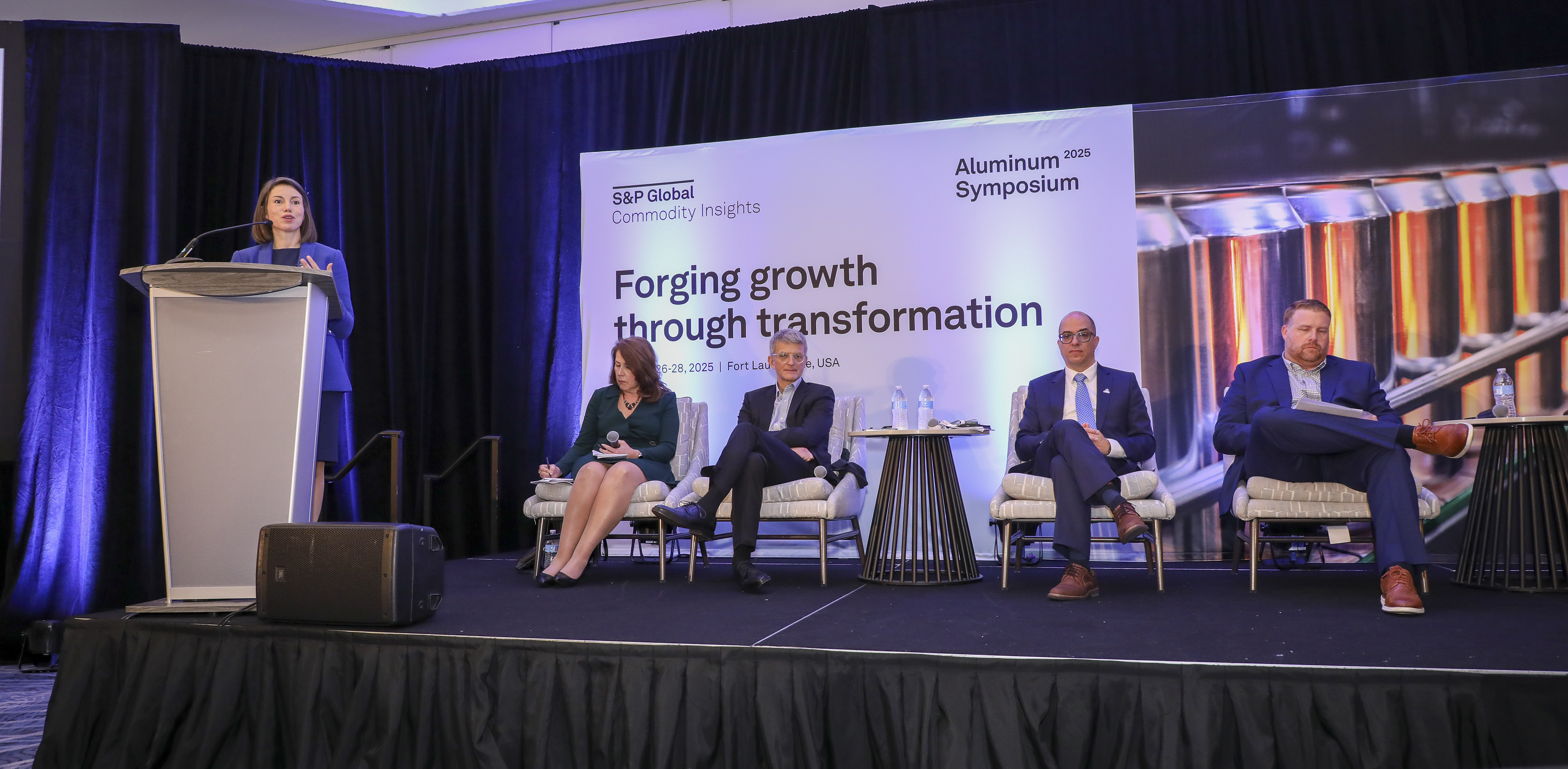
US import tariff plans and the potential impact on trade flows, economic growth and the Platts-assessed benchmark US Midwest premium preoccupied delegates at the 37th Aluminum Symposium held in Fort Lauderdale, Florida in late January.
Long term, aluminum’s green credentials in sectors including automotive and clean energy, prompted broad agreement on the urgent need to meet its strong growth profile with better recycling rates and recoveries to supplement low carbon primary metal supply.
Here are our five main takeaways from the event:
While it may seem counter-intuitive, given its heavy dependence on imports, the US was widely expected to impose import 25% tariffs on close trading partners in aluminum Canada and Mexico. That decision was confirmed on Feb. 1 with President Trump signing executive orders. The tariffs are viewed by many as negotiating tools that might be in place only temporarily, as was the case in Trump 1.0, with the aim primarily at securing other important concessions. Trade partners have since spoken of imposing retaliatory tariffs on the US.
However, it was mooted that trade flows might become less logical and less optimal. Given that Canada accounts for around two-thirds of the country’s total imports of primary metal, the US would likely have to import a lot of its needs from elsewhere to avoid huge price increases for consumers. Some pointed out that US consumers are already under strain.
The consensus was that Canada could divert shipments to the EU, as indicated recently by Alcoa, while the Middle East and possibly also India would in turn divert material from the EU to the US, providing tariffs were not punitive.
Long term restarts of idled capacity in the US also were not ruled out, as well as new capacity from Century Aluminum’s greenfield project. This could be incentivized by expected higher prices, thus perhaps helping to satisfy the new administration’s desire for the US to become more self-sufficient. However, competitive green power would be needed. Active US primary aluminum capacity has shrunk markedly since the 1980s. In 2024, the US produced just 677,984 metric tons (t) of metal, down 13.6% from the previous year’s 784,853 t.
A poll conducted by S&P Global at the event found that most delegates expected the benchmark US Midwest premium to average between 25 to 30 cents a pound this year. This view was likely influenced primarily by expectations of those higher import tariffs. The premium was last traded at $25.25 cents a pound on Jan. 31, its highest since April 2023.
Most poll voters also expected the LME 3M price 2025 average to fall within a $2,500-2,700/t range in 2025.
The price was last at $XXXX/t on Jan. XX. We currently forecast LME 3M will average $2,595/t this year, a 5.6% increase from that achieved last year. This is premised on a slightly slower demand growth environment being matched by a similar pace for production that leaves the market in a very modest surplus.
Supply disruptions, particularly for upstream bauxite and alumina, are expected to be less of a factor this year. While not a base case assumption, China’s heavy dependence on exports from Guinea might be considered a potential point of failure if there are further disruptions there.
However, if the ramp-ups of new projects such as PT Aneka Tambang’s high profile 1.0 million metric tons/year Mempawah Smelter Grade Aluminum refinery in Indonesia fall behind schedule then the alumina market may become more nervous. This in turn might put a temporary stop to the recent sharp decline in alumina prices, which saw the benchmark Alumina FOB Australia last assessed at $525/t.
China’s heavy dependence on exports from Guinea was identified at the Symposium as a potential single point of failure for the top producer’s alumina and aluminum output. Any significant disruptions upstream would likely support aluminum prices at higher levels than our base case scenario suggests.
Aluminum demand growth is expected to slow this year, but not substantially and its overall prospects remain bright long term. The real estate sector in top consuming country China was expected to remain a negative over the next few years, but power grid spend could help "keep the lights on".
Consumption related to energy transition was expected to remain a key influence in the years ahead, stemming from battery electric vehicles (BEVs) and renewable energy, coming mainly, but not exclusively, from solar power. It was thought that these growth prospects had helped to keep aluminum prices at around the $2,600/t level.
Lightweighting remains the driving force in BEVs with aluminum’s increasing usage in car bodies and battery housings highlighted. Light commercial vehicles were singled out for especially strong growth.
In the case of battery housings, it was noted that aluminum might face increasing competition, most notably from steel. Data centers were also identified as an area with strong growth prospects for connecting to the grid.
Recycling to gain in importance, but challenges ahead
In the US, recycling rates of the most easily recyclable product, Used Beverage Cans (UBCs) fell to a woeful level of around 40% in 2023, most recent data from the Aluminum Association showed. This compares with an average since records began in 1990 of just over 50%, and underscores the need for change. UBCs are deemed the lowest hanging fruit for recycling.
It was concluded that a better handle was needed on exactly how much aluminum scrap the US exports, particularly since this could satisfy hundreds of thousands of tons of demand.