Despite challenges, US energy investors, policymaker see energy transition growth
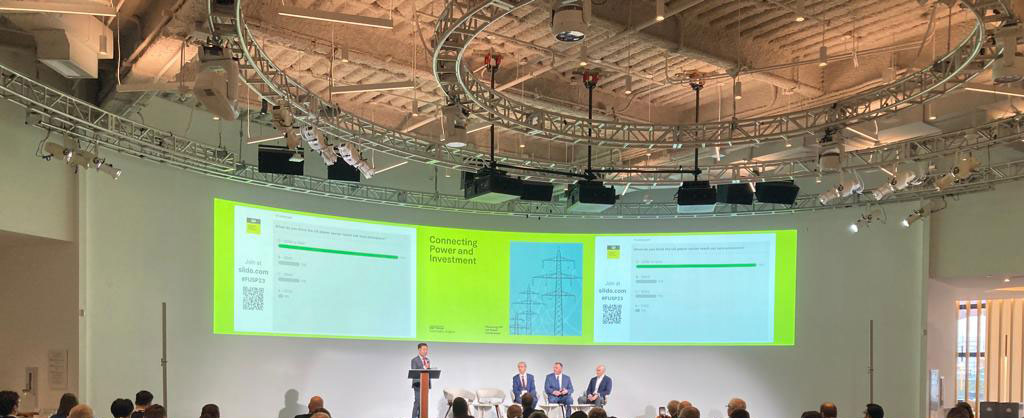
As US power market participants grapple with recent offshore wind industry challenges, there is expectant optimism about the US Inflation Reduction Act shifting to a more actionable phase for investors as further guidance around tax credits emerges, which could help foster a long-term growth trend for distributed energy generation and associated infrastructure, experts said Oct. 30.
With offshore wind projects across the US Northeast struggling due to higher costs than when power purchase agreements were signed, New York regulators in October dismissed a request by several developers to raise the contracted offtake price they accepted in their contracts following competitive solicitations.
"I work in a world where there is some dissonance going on at the moment," Doreen Harris, president and CEO of the New York State Energy Research and Development Authority, said during the S&P Global Financing US Power Conference that was held in New York City.
New York’s landmark climate law, the Climate Leadership and Community Protection Act, mandates 100% zero-emissions power by 2040 and a big part of meeting that target is predicated on 9 GW of offshore wind power capacity by 2035.
The development pipeline for those offshore wind projects was moving ahead fairly smoothly until armed conflict in Europe rippled through global energy markets, Harris said, with significant impacts in New York on things like supply chain costs and bottlenecks.
"As policymakers we recognize that we have to create that durable market signal in order for the markets to invest and that’s really what New York’s climate law has done," she said.
The scoping plan for how to enact the climate law considered "massive load growth – a doubling of our load in the state over the coming decades" and reliance on a 15 GW of zero-emissions dispatchable resources to balance out the renewable generation, Harris said.
The state had built up a 14-GW portfolio of projects that signed power delivery contracts with NYSERDA that would have gotten the state very close to another of its goals which is to have 70% renewable power by 2030.
The global energy crisis of the past few years impacted New York projects due to increases in inflation, supply chain constraints and interest rate volatility that caused problems for project developers, Harris said.
This resulted in most of that 14 GW pipeline of projects seeking to renegotiate their contract terms. "We as a state are making quick work to assess the status of these pipeline projects to determine which could advance, which will not and ultimately backfill any gaps lost through attrition of that portfolio," she said.
There is a proceeding underway at the New York Public Service Commission into what constitutes a zero-emissions dispatchable resource and what policies will be needed to build them.
That proceeding will be "critical" and will "set the stage for the next decade of investments past 2030 … and the massive amount of electrification that will come with it," Harris said.
Infrastructure investment
For renewables to continue penetrating the market, broad support is needed in transmission, smart meters, behind-the-meter technology, and infrastructure for electrifying transport, David Giordano, global head of BlackRock Climate Infrastructure, a division within investment giant Blackrock, said.
"We are looking as a firm at the transition to a low-carbon economy as the greatest movement of capital I would argue any of us will see in our careers from a macro-economic level," he said.
By 2030, $4.5 trillion could be invested in the energy transition in the US. "We’re talking about a massive shift in capital deployed," Giordano said.
Additionally, though often cited as a challenge, interest rate increases could actually create more resilience in projects and the transparency that higher rates will create will result in a more stable investment foundation, he said.
Giordano also said individual and corporate interest in decarbonization appears to be making people more willing to pay to pay a bit more for lower-carbon goods and power.
Globally, people are looking for something that is reliable and to account for the amount of carbon that goes into the goods and services they are consuming which will have an inflationary impact on pricing, but the urgency to decarbonize will counterbalance the pressure on pricing, he said.
Himanshu Saxena, CEO, of Lotus Infrastructure Partners, formerly branded as Starwood Energy, said almost all energy sectors have been impacted by the US Inflation Reduction Act and investors are waiting for some additional information from the US Internal Revenue Service on tax credits for hydrogen and carbon capture.
A lot more can happen next year depending on IRS guidance, it could be a "year of execution," he said.
The last year has been about preparing for new opportunities, Rich Roloff, managing director at LS Power, said. "We see this as probably an eight- or ten-year secular growth cycle from here," Roloff said.